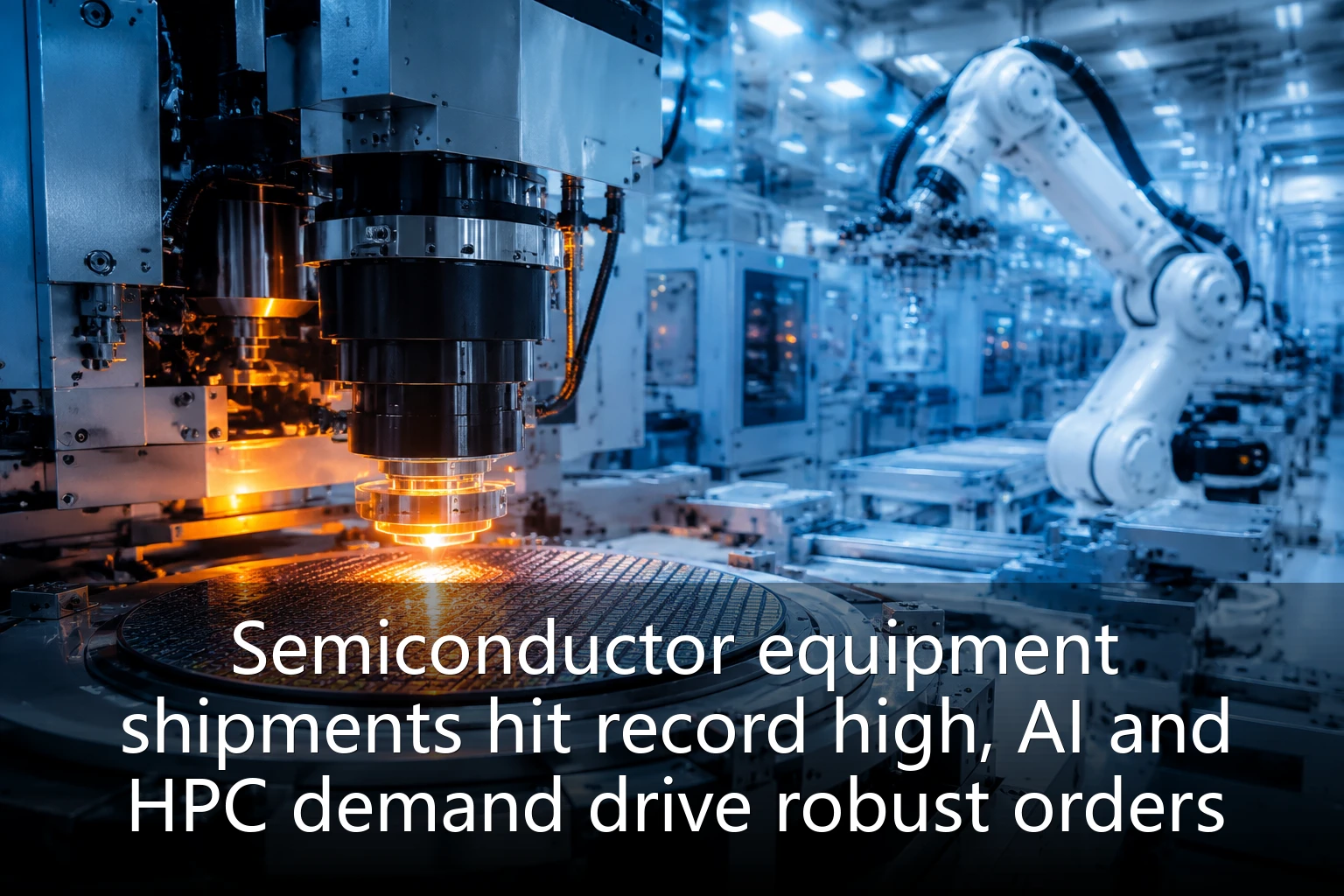
The global semiconductor equipment market achieved a historic breakthrough in Q2 2026. According to the latest data from SEMI, global semiconductor equipment shipments reached $29.8 billion in Q2 2026, up 12% year-over-year and 5% sequentially, marking the highest quarterly level since records began in 1976. This data indicates that, driven by strong demand from artificial intelligence (AI) and high-performance computing (HPC), the semiconductor equipment industry has entered a new upcycle.
Surge in demand for advanced process equipment
By equipment type, lithography machines, etching equipment, and thin-film deposition equipment were the main growth drivers. Equipment makers such as ASML, Applied Materials, and Lam Research saw orders in Q2 2026 exceeding market expectations. Among them, EUV lithography machine shipments reached 15 units, an increase of 3 units compared to the same period last year, mainly purchased by TSMC, Samsung, and Intel for expansion of 3nm and 2nm processes. For etching equipment, as 3D NAND layers exceed 500 and HBM stacking layers increase, high-aspect-ratio etching demand drove etching equipment shipments up 8% sequentially.
Regional distribution: Mainland China, South Korea, and Taiwan lead
By region, Mainland China continued to rank first globally with shipment value of $8.5 billion, up 14% year-over-year, mainly benefiting from mature process expansion and domestic equipment substitution. South Korea followed with $7.2 billion, where memory chip makers Samsung and SK Hynix invested heavily in process upgrades for HBM and DDR5 memory. Taiwan ranked third with $6.5 billion, driven mainly by TSMC's continued investment in advanced processes. Europe and North America recorded $3.8 billion and $2.8 billion respectively, with relatively stable growth, but export controls due to geopolitical factors constrained flows of some high-end equipment.
Industry background and cycle interpretation
The semiconductor equipment market experienced a brief adjustment in 2025, with full-year shipments dropping to about $98 billion due to high global chip inventory and weak end demand. Entering 2026, with surging demand for advanced chips from AI computing, HPC servers, and smart vehicles, chip makers resumed expansion plans. SEMI estimates that full-year semiconductor equipment shipments in 2026 could exceed $110 billion, setting another record high.
- AI chip driven: AI accelerator orders from NVIDIA, AMD, and Google remain robust, pushing TSMC and Samsung's sub-5nm process capacity utilization above 95%, with corresponding equipment procurement demand strong.
- HBM memory: Competition between SK Hynix and Micron on HBM3E and HBM4 processes intensifies, driving investment in advanced packaging and stacking equipment.
- Mature processes: Chinese wafer foundries such as SMIC and Hua Hong Semiconductor continue to expand, contributing a significant share of equipment demand.
Industry views and outlook
Investment bank Morgan Stanley recently released a report stating that the semiconductor equipment industry is in the early stages of a "super cycle", benefiting from the doubling of equipment investment required per chip process generation upgrade, making equipment companies among the biggest winners of AI infrastructure buildout. However, it also warned that geopolitical risks and equipment export controls could create uncertainty for some companies' orders.
Singapore, as a key node in the global semiconductor industry, is also a critical link in the equipment supply chain. Multiple equipment suppliers such as KLA and TEL have manufacturing and R&D centers in Singapore. Some technology stocks listed on the Singapore Exchange, including UMS Holdings and AEM (equipment component suppliers), are also expected to benefit from the equipment investment boom.
Overall, the record-high equipment shipments in Q2 2026 mark the semiconductor industry's exit from the adjustment period into a new AI-driven growth cycle. Going forward, attention should be paid to the direction of US technology control policies toward China and the progress of tripartite game among China, the US, and Europe in the chip equipment sector.