Introduction: Historic Turning Point for Silicon Wafers as Material Deflation Ends
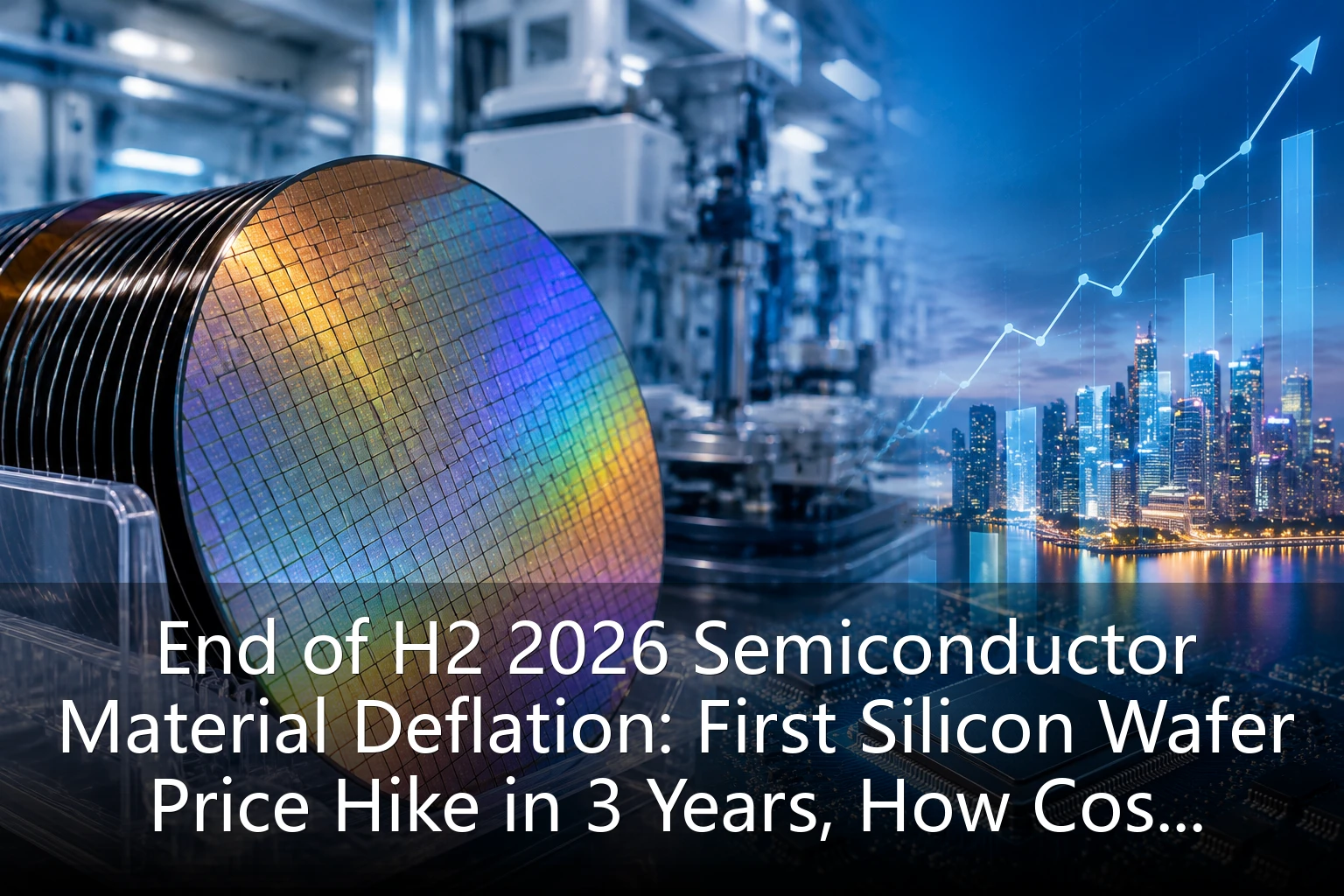
In early August 2026, news emerged from the upstream global semiconductor supply chain sufficient to trigger a valuation restructuring across the entire chip industry: major international silicon wafer suppliers issued formal notices to foundries and IDM clients, planning to raise prices across all wafer categories from late Q3 to early Q4. This marks the first substantial price increase in the global semiconductor silicon wafer market since H2 2023, signaling the definitive end of a three-year "deflationary cycle" on the materials side. For semiconductor manufacturing, which heavily relies on economies of scale, silicon wafers serve as the "foundation" of chipmaking. Price fluctuations not only cap foundry gross margins but also transmit through the supply chain, ultimately reshaping global chip market pricing logic and investment narratives.
As professional observers focused on the Singapore Exchange (SGX) tech and semiconductor sectors, we believe this wafer price hike is not an isolated event, but an inevitable result of deep structural changes in global semiconductor supply and demand in the post-Moore era. With AI computing demand growing exponentially and advanced process capacities remaining fully loaded, rising silicon costs are becoming a new engine forcing chip market dynamics to shift toward "value re-rating." This article delves into the surface phenomenon of wafer price hikes, deeply analyzing the underlying industrial logic, transmission effects on the global chip supply chain, and the investment opportunities and challenges for SGX-listed tech companies.
1. Behind the First Wafer Price Hike in Three Years: Supply-Demand Mismatch and Structural Shortage
As the most critical foundational material in the semiconductor supply chain, silicon wafer price trends are seen as a "barometer" of industry prosperity. From 2023 to 2025, impacted by a weak global consumer electronics market, declining fab capacity utilization, and the concentrated release of new wafer supplier capacities, the wafer market endured a long destocking cycle with prices slipping continuously. However, entering 2026, this trend underwent a fundamental reversal.
1. AI and Advanced Processes Ignite Demand for 12-inch Heavily Doped Wafers
In this wafer price hike, the most significant increases are concentrated in 12-inch heavily doped wafers and some high-end polished wafers (PW). The reason is that in H2 2026, global AI computing infrastructure entered an accelerated deployment phase, with shipments of AI chips represented by GPUs and HBM (High Bandwidth Memory) continuing to climb. These high-performance chips not only demand extremely fine line widths in logic processes but also impose unprecedentedly stringent standards on substrate wafer purity, flatness, and mechanical strength.
With advanced processes (such as 3nm and below) running at full capacity, foundries are consuming high-quality wafers at a rate far exceeding expectations. Meanwhile, the widespread adoption of advanced packaging technologies (like Chiplet and 2.5D/3D packaging) has multiplied the wafer area consumed by a single system-level chip. This shift from "transistor scaling" to "packaging area expansion" has directly ignited structural demand for 12-inch large-sized wafers.
2. Supply Contraction: Capacity Lag and Capex Barriers Under the Bullwhip Effect
Compared to explosive demand growth, the recovery on the wafer supply side has been extremely sluggish. Manufacturing semiconductor-grade silicon wafers involves high technical and capital expenditure barriers, typically requiring an 18 to 24-month cycle from new fab construction to stable product supply. After enduring the industry downturn of the previous two years, major global wafer suppliers (such as Japan's Shin-Etsu Chemical and SUMCO) have been highly cautious with capital expenditures, strictly controlling the rollout of new capacity.
Furthermore, the bullwhip effect in wafer manufacturing has led to periodic tightness in upstream polysilicon raw materials and quartz crucibles. Scarcity of some high-purity quartz sand has kept crucible prices high, further pushing up wafer manufacturers' production costs. Driven by both cost-push and demand-pull factors, wafer suppliers have finally reached a window for price increases.
2. How Cost Restructuring Transmits to Foundries and IC Design: Profit Game Intensifies
The rise in wafer quotes is far more than a simple increase in material costs; it is profoundly changing the profit distribution landscape among upstream and downstream enterprises in the semiconductor supply chain. For foundries and IDMs highly dependent on wafer inputs, digesting this cost pressure will become a core operational issue from H2 2026 through 2027.
1. Foundries' "Double Squeeze" and Pricing Momentum
Currently, the global foundry market is deepening its "two-track" phase: advanced processes are in short supply with full capacity, while mature processes face pricing pressure amid a slow recovery. Rising wafer costs have vastly different impacts on these two segments.
For foundry giants mastering advanced processes, their strong bargaining power in the supply chain means rising wafer costs will naturally transmit to downstream clients. We expect that from Q4 2026 to early 2027, advanced process foundry quotes will further stack material cost premiums on top of previous price hikes, with overall gross margins likely maintained at high levels or even slightly revised upward. These companies will successfully pass on costs and potentially optimize their profit structures.
However, for foundries relying primarily on mature processes, the situation is more difficult. Mature process clients are highly price-sensitive, and with demand not yet fully recovered, foundries struggle to pass on wafer costs through significant price hikes. This will pressure the short-term gross margins of mature process foundries, potentially accelerating industry consolidation and M&A.
2. IC Design Firms Face Rising BOM Costs, Industry Polarization Intensifies
The ultimate bearers of wafer price hikes will be downstream IC design companies. As wafer manufacturing costs transmit, the BOM (Bill of Materials) costs for IC design firms will inevitably rise. For AI chip designers and high-end analog chipmakers with high margins and irreplaceable products, this cost increase can be easily digested through product iteration and premium pricing.
But for IC design firms targeting fiercely competitive markets like consumer electronics and low-end industrial control, rising costs will directly erode their already thin profit margins. Unable to effectively raise prices, these companies will have to optimize chip areas, adopt more economical packaging solutions, or seek multi-source wafer supplies to hedge cost risks. This "butterfly effect" originating from the materials side will accelerate the survival of the fittest in the IC design industry, driving resources toward leading companies with core technical barriers and pricing power.
3. Underlying Logic of the Post-Moore Era: Material Innovation Becomes New Anchor for Chip Investment
The wafer price hike superficially reflects a short-term supply-demand mismatch, but its underlying logic is that as Moore's Law approaches physical limits, relying solely on transistor scaling to improve chip performance is increasingly difficult and expensive. The semiconductor industry is undergoing a paradigm shift from "dimension scaling" to "materials and structural innovation."
1. Wafers Evolve Toward "Specialization": Epi Wafers and SOI Demand Surge
While traditional polished wafer prices recover, demand for high-end wafers like epitaxial wafers and Silicon-on-Insulator (SOI) is showing explosive growth. Epi wafers, grown by depositing a layer of single-crystal silicon on a substrate, effectively reduce leakage current and improve device performance, becoming standard for advanced process logic chips and power semiconductors (like SiC and GaN-on-Si). SOI wafers, with excellent high-frequency and low-power characteristics, show immense potential in RF chips, automotive radar, and advanced packaging.
This trend indicates that wafers are no longer just homogeneous standard commodities, but are evolving into highly customized, specialized high-tech materials. Suppliers with R&D and mass-production capabilities for high-end wafers will capture excess profits in future market competition, providing new investment clues for the capital markets.
2. Material Innovation Breaks Computing Bottlenecks: Extending from Silicon to Multi-Material Systems
The wafer price hike also reflects the industry's urgent need for next-generation semiconductor materials. Against the backdrop of AI computing's stringent requirements for interconnect bandwidth and power consumption, silicon photonics, glass substrates, and new wide-bandgap semiconductor materials are becoming focal points for industrial capital. These new materials not only surpass traditional silicon-based materials in physical performance but are also reshaping chip packaging and interconnect architectures.
For investors, understanding the innovation logic on the semiconductor materials side is more important than merely tracking short-term price fluctuations. Material innovation is becoming the key path to breaking computing bottlenecks and extending the economic effects of Moore's Law. Startups with deep R&D accumulation in materials and giants with tight upstream-downstream coordination will become core assets for chip investment over the next decade.
4. SGX Tech Sector Valuation Restructuring: Strategic Opportunities in Singapore's Semiconductor Ecosystem
As a key hub for the global semiconductor industry, Singapore hosts a range of top global companies spanning wafer fabrication, packaging and testing, and semiconductor equipment and materials. The rise in wafer quotes and the shifting logic on the materials side will have profound strategic impacts on tech and semiconductor-related companies listed on the Singapore Exchange (SGX), spurring a new round of valuation restructuring.
1. Profit Elasticity in Local Wafer Fabrication and OSAT Sectors
Singapore boasts a comprehensive wafer fabrication ecosystem, with several global-class foundries and IDMs holding significant capacity there. Amid wafer price hikes, local foundry capacity will benefit from the pricing effects of advanced processes. SGX-listed semiconductor companies equipped with advanced process capacities and high-end packaging capabilities are expected to show significant profit elasticity during cost pass-through.
Additionally, Singapore holds traditional advantages in semiconductor packaging and testing. As advanced packaging technologies like Chiplet increase wafer consumption, local OSAT firms will not only secure more orders but also partially shield themselves from upstream wafer price shocks by providing high-value-added packaging services, thereby maintaining stable gross margins.
3. Cross-border Policies and Supply Chain Resilience: Singapore's "Safe Haven" Effect
As the global semiconductor supply chain faces geopolitical maneuvering and tariff policy uncertainties, Singapore, with its neutral political stance, robust IP protection system, and deep industry cluster effects, is becoming a "safe haven" for global semiconductor capital hedging and deployment. Supply chain tensions triggered by wafer price hikes will prompt more multinational semiconductor companies to reassess their supply chain resilience, accelerating the establishment of diversified capacities in Southeast Asia.
This will bring continuous foreign capital inflows and technology spillover effects to Singapore's semiconductor industry, further consolidating its core position in the global semiconductor supply chain. For the SGX tech sector, this macro-level supply chain restructuring will provide long-term fundamental support, attracting sustained allocation from global long-term funds.
5. Investment Strategy and Risk Warnings: Grasping the Intersection of Material Cycles and Growth Attributes
Facing the cost-side restructuring triggered by rising wafer quotes, investors positioning in the semiconductor market need to shift from traditional "cyclical thinking" to a composite logic of "growth plus cycle."
1. Favor Sector Leaders with Cost Pass-through Capabilities
At this stage, the core of investing in chip stocks lies in finding companies with "pricing power." We recommend focusing on foundry giants and AI chip design leaders that possess technical barriers in advanced processes, have high-quality downstream customer structures, and face supply shortages. These companies can smoothly transmit wafer costs to end-users or even capture excess profits amid supply-demand imbalances.
2. Uncover "Hidden Champions" in Materials and Equipment
Compared to finished chip volatility, the performance certainty in semiconductor materials and equipment is higher. We suggest paying attention to "hidden champion" companies on the SGX with deep moats in key wafer manufacturing consumables, advanced process metrology equipment, specialty gases, and wide-bandgap semiconductor materials. Under the major material innovation cycle, the growth space for these companies will far exceed traditional cyclical stocks.
3. Beware of Risks of Demand Falling Short of Expectations
Although wafer price hikes reflect current supply tightness, if the global macroeconomy experiences an unexpected recession in H2 2026, leading to a double-dip in consumer electronics and automotive chip demand, wafer price hikes will be unsustainable and may even trigger inventory games between foundries and material suppliers. Investors must closely track monthly global semiconductor sales data and changes in major foundry capacity utilization to guard against cycle reversal risks.
Conclusion: Slight Wafer Price Hikes Reflect Massive Industry Shifts; Chip Investment Enters Era of "Intensive Cultivation"
This round of wafer quote increases in August 2026, while perhaps not staggering in magnitude, carries signaling significance far greater than its actual financial impact. It declares the end of deflation in semiconductor materials and indicates that chip industry investment logic is undergoing a profound transformation from "scale expansion" to "value creation." In the post-Moore era, material innovation, supply chain resilience, and advanced packaging technologies will become key variables determining the success or failure of chip companies.
For investors watching the SGX tech and semiconductor sectors, this is both a challenge and an opportunity. Against the backdrop of cost-side restructuring, only by deeply understanding the changes in the underlying logic of the semiconductor supply chain can one clear the clouds in a complex and volatile market, accurately capturing the core assets of the next super cycle. As a key node in the global semiconductor landscape, Singapore's listed tech companies will undoubtedly demonstrate unique investment value and growth resilience to global capital markets amid this round of industrial upgrades.