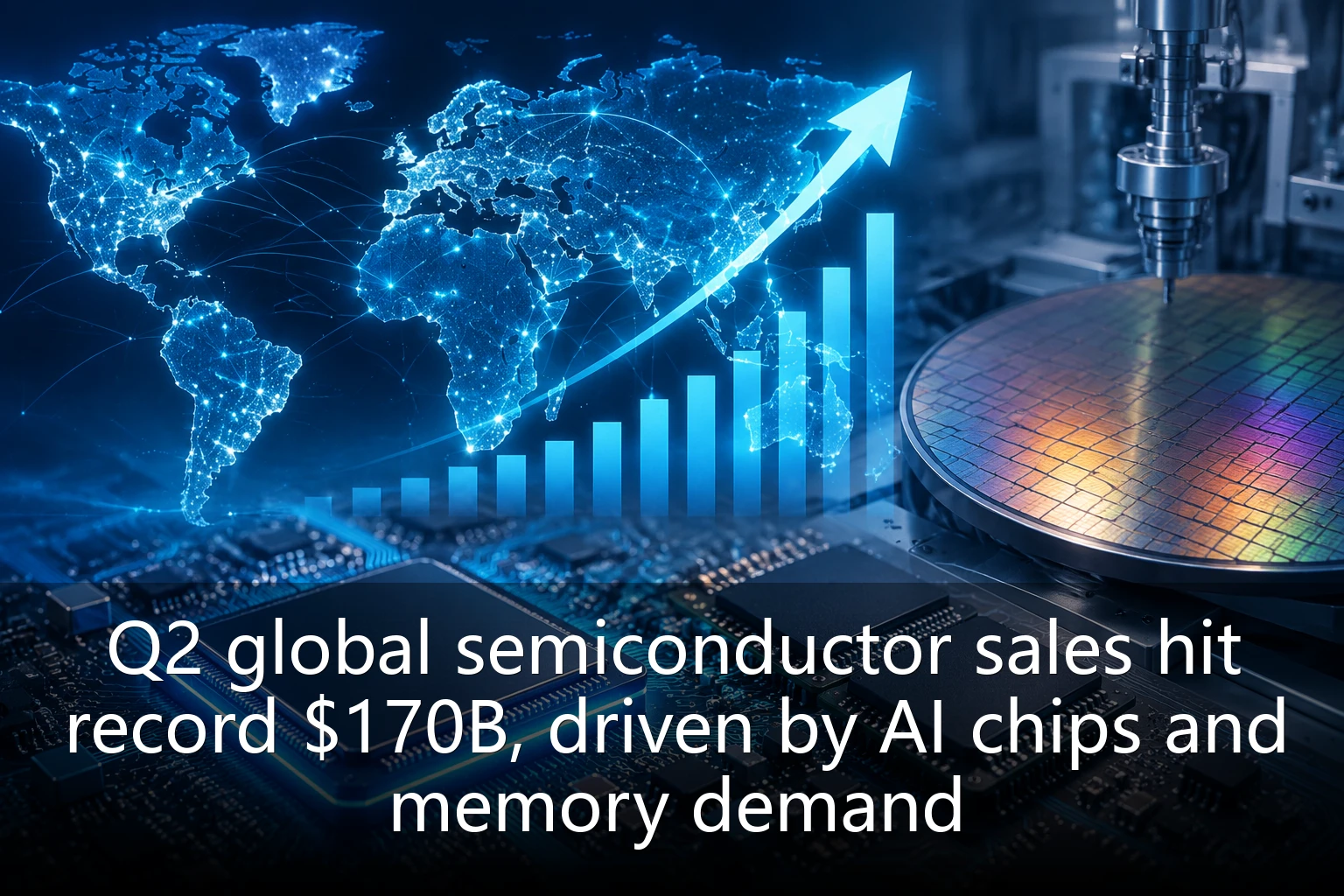
On July 28, 2026, the Semiconductor Industry Association (SIA) released data showing Q2 2026 global semiconductor sales reached $170 billion, up 18% YoY and 8% QoQ, a quarterly record. This far exceeded expectations, indicating the industry has fully entered a new upcycle after the 2023-2024 inventory correction.
AI Chip Demand Surges as Core Growth Engine
By segment, AI chips (including GPUs, ASICs, FPGAs) saw sales up 45% YoY, rising from 8% to 12% of total semiconductor sales. Major tech companies like Amazon, Google, Microsoft, and Meta continue heavy AI infrastructure investment, with combined 2026 capex estimated over $350 billion, about 60% for AI servers and data centers. Chinese AI chip companies such as Cambricon and Huawei Ascend have seen shipments up over 80% YoY, further boosting demand.
Memory Chip Prices Rebound, Margins Improve Sharply
The memory chip market was another highlight. DRAM and NAND Flash sales grew 22% and 31% YoY, with prices bottoming out in Q2 after an 18-month decline. Samsung, SK Hynix, and Micron, after capacity cuts, pushed contract prices up 15%-20%. Samsung's semiconductor division quarterly profit surged 340% QoQ to $8.9 billion; SK Hynix turned profitable with net profit of $2.7 billion. Analysts note that surging demand for high-bandwidth memory (HBM) in AI servers is key to pricing recovery — HBM3E products are in short supply, with prices 4-5x that of standard DRAM.
Foundry Utilization Rates Recover, Mature Process Demand Stable
The foundry sector also saw an upturn. TSMC, Samsung, and GlobalFoundries averaged 95% utilization in Q2, up from 88% in Q1. TSMC's 3nm and 5nm nodes are near full capacity, with orders booked into Q1 2027. Notably, mature processes (28nm and above) did not weaken as expected, driven by automotive, IoT, and industrial chips; SMIC and Hua Hong maintain utilization above 90%. Average wafer selling price (ASP) rose 3% QoQ, with 12-inch wafers around $5,000 and 8-inch around $1,800.
Supply Chain: Lead Times Lengthen, Inventory Levels Healthy
Due to surging demand, chip lead times slightly extended in Q2. According to Susquehanna Financial Group, global average lead time was 24.6 weeks in June, up 1.2 weeks from March, still well below the historical peak of 40 weeks. MCUs, power management ICs, and automotive chips saw longer lead times, some exceeding 30 weeks. Overall industry inventory fell from 90 days at end-2025 to 78 days, near healthy levels (60-80 days), indicating the destocking phase is largely over and real demand is driving replenishment.
Regional Performance: Americas Lead, Asia-Pacific Steady
By region, Americas Q2 sales grew 25% YoY, driven by AI and memory chips. Asia-Pacific/All Other (ex-China and Japan) grew 21%, China 15%, Europe 12%, Japan 8%. Despite escalating US export controls on China, the Chinese semiconductor market maintained double-digit growth thanks to domestic demand and import substitution. Singapore, a Southeast Asian semiconductor hub, saw Q2 semiconductor exports up 18% YoY, with wafer fab equipment and chip components trade particularly strong.
Outlook: H2 Growth May Slow, but Full Year Could Set New Record
Looking ahead, the SIA expects Q3 sales to grow 5%-7% QoQ, with Q4 possibly slowing to 2%-4% due to seasonality, but full-year sales could reach $680-700 billion, surpassing the 2022 record of $650 billion. Risks include geopolitical tensions, potential further US export restrictions on chip equipment to China, and global economic uncertainty. Some analysts warn of possible AI chip demand bubbles, but investment and technology spend will likely continue in the near term.
For procurement and investment decisions, the market is in early upcycle with strong supplier price hike intentions. Downstream customers are advised to moderately increase safety stock and consider mature-process alternatives. In the secondary market, the global semiconductor index (SOX) has risen 12% since June, with PE valuations above historical medians; investors should select targets with core technology and capacity moats.
Several semiconductor-related stocks listed on the Singapore Exchange have performed well recently, such as UMS Holdings and AEM, benefiting from wafer fab equipment demand, with stock prices hitting year highs. The SGX Semiconductor ETF (ticker: SCD) posted a total return of 14% in Q2, with net inflows over S$100 million, reflecting market optimism.
Overall, Q2 2026 semiconductor market exceeded expectations, with AI and memory as dual engines injecting strong momentum. However, supply chain risks persist, and technology advances intertwine with geopolitical games. Participants should stay vigilant and capitalize on price fluctuation windows.