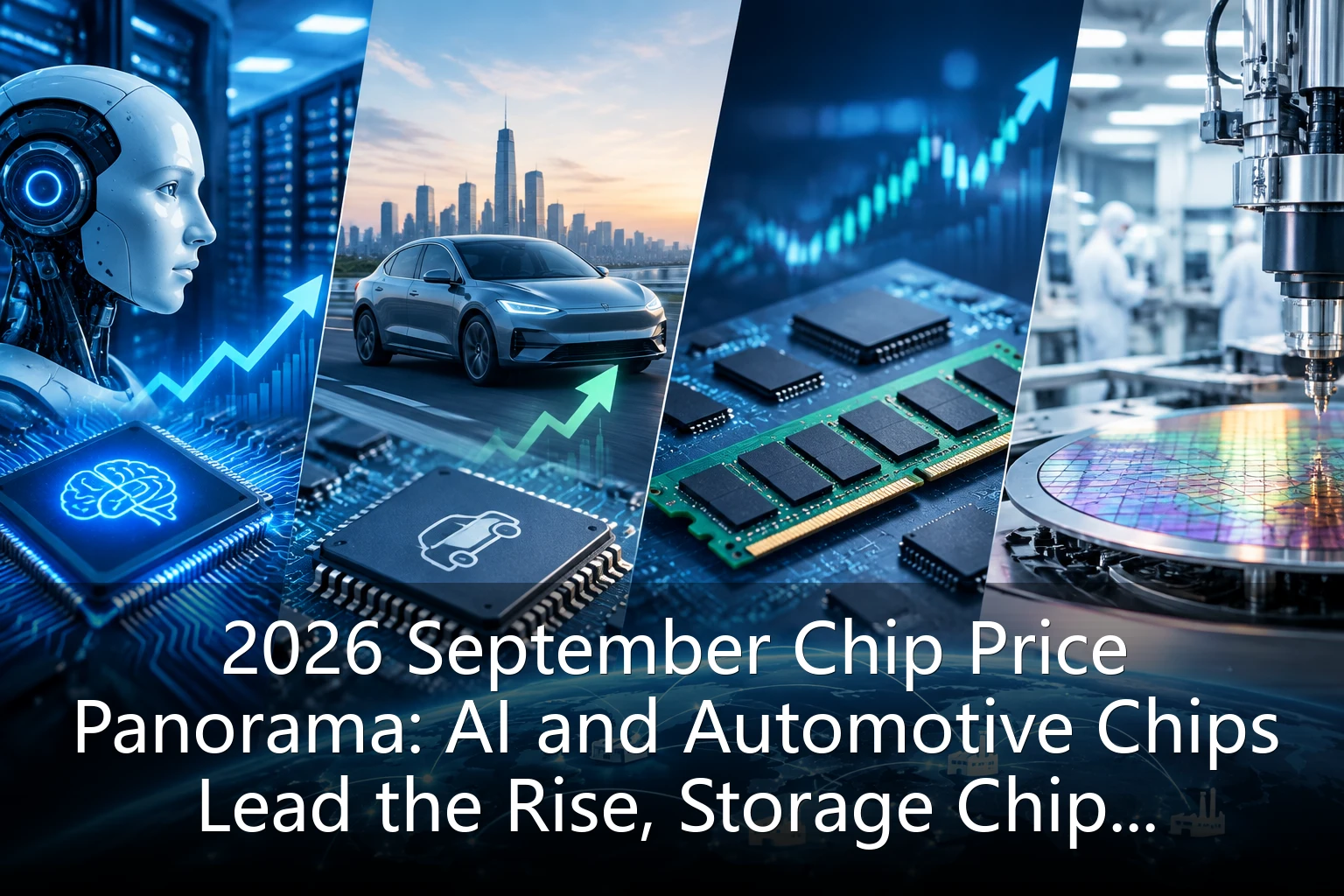
2026 September Chip Price Panorama: AI and Automotive Chips Lead the Rise, Storage Chips Approach Recovery Turning Point
\nThe global chip market in September 2026 presents unprecedented structural differentiation. With the explosive growth of artificial intelligence technology and the acceleration of automotive electrification and intelligentization, AI chips and automotive chips continue to rise in price, while the storage chip market, after a long period of adjustment, has reached a clear recovery turning point. The foundry market shows obvious "dual-track" characteristics, with advanced process capacity constraints leading to price increases, while mature processes tend to stabilize in price. This series of changes is reshaping the global semiconductor industry chain structure, bringing new opportunities and challenges for investors and procurement decision-makers.
\n\nAI Chip Prices Continue to Rise, Supply-Demand Imbalance Worsens
\nIn the third quarter of 2026, AI chip prices continued the upward trend from the first half of the year, with some high-end AI processors showing year-over-year price increases of over 30%. This phenomenon is mainly due to the explosive growth of generative AI applications and the exponential demand for computing power in large model training and inference. According to market research data, global data center AI chip demand increased by more than 150% year-over-year, while capacity growth during the same period was only about 30%, indicating a serious supply-demand imbalance.
\nIn the AI chip field, high-end GPUs and specialized AI accelerators showed the most significant price increases. NVIDIA's latest generation of data center GPUs is priced 35% higher than at the beginning of the year, with price increases in some third-party distribution channels exceeding 40%. Meanwhile, the price of HBM (High Bandwidth Memory) required for AI training has also risen, further increasing the overall cost of AI systems.
\nThis price trend reflects the strong market demand for AI chips, but has also raised industry concerns about an "AI bubble." Several analysts pointed out that the current price increase in AI chips is partly due to short-term supply-demand imbalances. In the long run, as more manufacturers enter the market, prices will gradually return to rational levels. However, this process may take 12-18 months, during which AI chip prices may continue to maintain a high level of fluctuation.
\n\nStrong Automotive Chip Demand, Prices Steadily Rise
\nThe automotive chip market in September 2026 showed a situation of both supply and demand flourishing, with prices showing a steady upward trend. As the penetration rate of new energy vehicles exceeds 40% and the level of automotive intelligence continues to improve, the chip usage per vehicle has continuously increased, from about 500 chips in 2022 to over 1000 now, with high-end intelligent models reaching even more than 1500 chips.
\nIn the automotive chip field, MCU (Microcontrollers), power semiconductors, and sensor chips have the strongest demand. Especially chips used for Advanced Driver Assistance Systems (ADAS) and autonomous driving have seen year-over-year price increases of 15%-20%. Meanwhile, with the increase in electric vehicle penetration, automotive-grade IGBT (Insulated Gate Bipolar Transistor) and SiC (Silicon Carbide) power devices have seen a surge in demand, with some suppliers' delivery times extending to more than 24 weeks.
\nAnother important factor in the rise of automotive chip prices is the continuous restructuring of the supply chain. After the chip shortage from 2020-2022, automakers began adopting "multi-source procurement" and "strategic inventory" strategies, further increasing market demand. At the same time, the extremely high requirements for reliability and safety in automotive chips make it difficult for new entrants to gain market recognition in the short term, leading to increased market concentration and stronger bargaining power for leading manufacturers.
\n\nStorage Chips Reach Recovery Turning Point, Price Rebound Significant
\nAfter a two-year adjustment, the storage chip market reached a clear recovery turning point in the third quarter of 2026. DRAM and NAND flash contract prices have risen for two consecutive quarters, with some products showing price increases of over 20%. This change marks the formal entry of the storage industry into a new upward cycle.
\nThe main driving forces for storage chip recovery come from three aspects: first, the explosion of AI applications has driven demand for high-performance storage, especially large-capacity HBM and high-speed DDR5 memory used for AI training; second, the PC and smartphone markets, after a period of weakness, have begun to recover, with inventory basically depleted; finally, major storage manufacturers have significantly reduced capital expenditures in the past two years, leading to limited new capacity that cannot meet the rapidly growing demand.
\nIn the细分 market, HBM and DDR5 memory have shown the most significant price increases, with some high-end HBM products rising more than 40% from the beginning of the year. In NAND flash, enterprise SSDs and high-capacity products for data centers have strong demand, while consumer products have shown relatively moderate growth. Storage manufacturers expect this upward price trend to continue at least until the first half of 2027, after which it may enter a period of moderate adjustment.
\n\nFoundry Market Differentiation: Advanced Process Price Increases, Mature Process Stabilizes
\nThe foundry market in September 2026 shows obvious "dual-track" characteristics. Advanced processes (7nm and below) face capacity constraints with continuously rising prices, while mature processes (28nm and above) have basically balanced supply and demand with stable prices.
\nIn the advanced process field, leading manufacturers like TSMC and Samsung have their 7nm, 5nm, and 3nm capacities operating at full capacity, with some customers needing to book capacity 12-18 months in advance. TSMC has announced that from the fourth quarter of 2026, its advanced process foundry prices will increase by 10%-15% to cope with rising equipment costs and technology R&D investment. Meanwhile, Intel has also re-entered the foundry market through its IDM 2.0 strategy, further intensifying capacity competition in advanced processes.
\nIn contrast, the mature process market presents a different picture. After nearly two years of price wars, prices for 28nm and above mature processes have stabilized, with some products even showing slight rebounds. This change is mainly due to the recovery of the consumer electronics market and increased demand for automotive electronics, while the Chinese government, through policies like the Big Fund, has supported domestic foundries to accelerate capacity expansion in mature processes, alleviating global supply pressure.
\nThis differentiation trend in the foundry market is expected to continue until 2027, with the premium for advanced processes further expanding, while mature processes will maintain relatively stable price levels. This change will also encourage chip design companies to more carefully select process nodes based on product characteristics and market demand, rather than blindly pursuing the most advanced processes.
\n\nSemiconductor Supply Chain Adjustments and Future Price Trend Predictions
\nIn 2026, the global semiconductor supply chain is undergoing profound adjustments, shifting from "lean production" to "strategic inventory" and "regional layout." This transformation is reshaping the price formation mechanism of the chip market, making price fluctuations more complex and diversified.
\nFrom a supply chain perspective, chip manufacturers are adopting more flexible pricing strategies, dynamically adjusting prices based on supply-demand relationships, customer relationships, and product life cycles. Meanwhile, as geopolitical factors have a deeper impact on the semiconductor industry, "supply chain security" and "technological autonomy" have become important factors affecting prices, with some countries and regions willing to pay higher premiums to ensure their local supply chain security.
\nLooking ahead 6-12 months, the chip market is expected to show the following price trends: AI chips and automotive chips will continue to maintain high prices, but the rate of increase may gradually narrow; storage chip prices will maintain an upward trend, but the growth rate may slow down; the foundry market will continue to differentiate, with significant upward price pressure for advanced processes while mature processes remain relatively stable; power semiconductors and sensor chips will have strong demand with steady price increases expected.
\nIn the long term, with technological innovation and industry maturity, chip prices will show structural changes. On one hand, the slowdown of Moore's Law for advanced processes leads to cost increases, which may push up high-end chip prices; on the other hand, the scale effects and process optimization of mature processes will keep mid-to-low-end chip prices relatively stable or even declining. This structural change will have a profound impact on the profit distribution and value chain restructuring of the entire semiconductor industry.
\n\nRecommendations for Industry Investment and Procurement Decisions
\nFacing the current complex and changing chip price trends, industry participants need to be more cautious and forward-looking in their investment and procurement decisions. The following are recommendations for different types of participants:
\n\nFor Investors
\n- \n
- Focus on the AI Industry Chain: AI chips, related software, and solution providers still have strong growth potential, but valuation risks need to be considered, choosing leading enterprises with high technical barriers and strong customer stickiness. \n
- Seize Automotive Chip Opportunities: With the acceleration of automotive intelligence and electrification, the automotive chip market will continue to grow, especially in the fields of MCUs, power semiconductors, and sensors. \n
- Pay Attention to Storage Cycle Turning Points: The storage chip industry has entered an upward cycle, but cyclical risks need to be noted, choosing leading enterprises with technical advantages and capacity control. \n
- Layout Advanced Packaging and Chiplet: As Moore's Law slows down, advanced packaging and Chiplet technologies have become important ways to enhance chip performance, with related companies having long-term investment value. \n
For Procurement Parties
\n- \n
- Establish a Diversified Supply Chain: Avoid over-reliance on a single supplier, especially in key chip areas, and establish a qualified supplier system with 2-3 suppliers. \n
- Implement Strategic Inventory Management: Formulate differentiated inventory strategies based on product life cycle and market demand, appropriately increasing safety stock for long-lead-time, high-risk key chips. \n
- Focus on Cost Optimization Opportunities: While meeting performance requirements, evaluate whether mature processes can replace advanced processes, or reduce chip usage through design optimization. \n
- Strengthen Supplier Relationship Management: Establish long-term strategic partnerships with core suppliers, enhancing supply chain resilience through joint R&D and capacity sharing. \n
For Industry Participants
\n- \n
- Technological Innovation is the Core Competitiveness: Facing rising costs and price pressures, continuous technological innovation is key to maintaining competitiveness, especially in the fields of heterogeneous integration, advanced packaging, and new materials. \n
- Flexibly Respond to Market Changes: Establish agile product development and market response mechanisms that can quickly adjust product strategies and pricing systems based on market demand changes. \n
- Strengthen Industry Chain Collaboration: Upstream and downstream enterprises should strengthen cooperation to jointly address supply chain challenges, improving overall efficiency through information sharing and collaborative innovation. \n
The chip market conditions in September 2026 indicate that the global semiconductor industry is undergoing profound changes. The differentiation of price trends reflects the multiple impacts of technological innovation, market demand, and supply chain restructuring. Facing this complex situation, industry participants need to maintain strategic focus, seize structural growth opportunities, effectively respond to cyclical fluctuation challenges, and find a balance point between technological innovation and supply chain resilience in order to remain invincible in the fierce market competition.