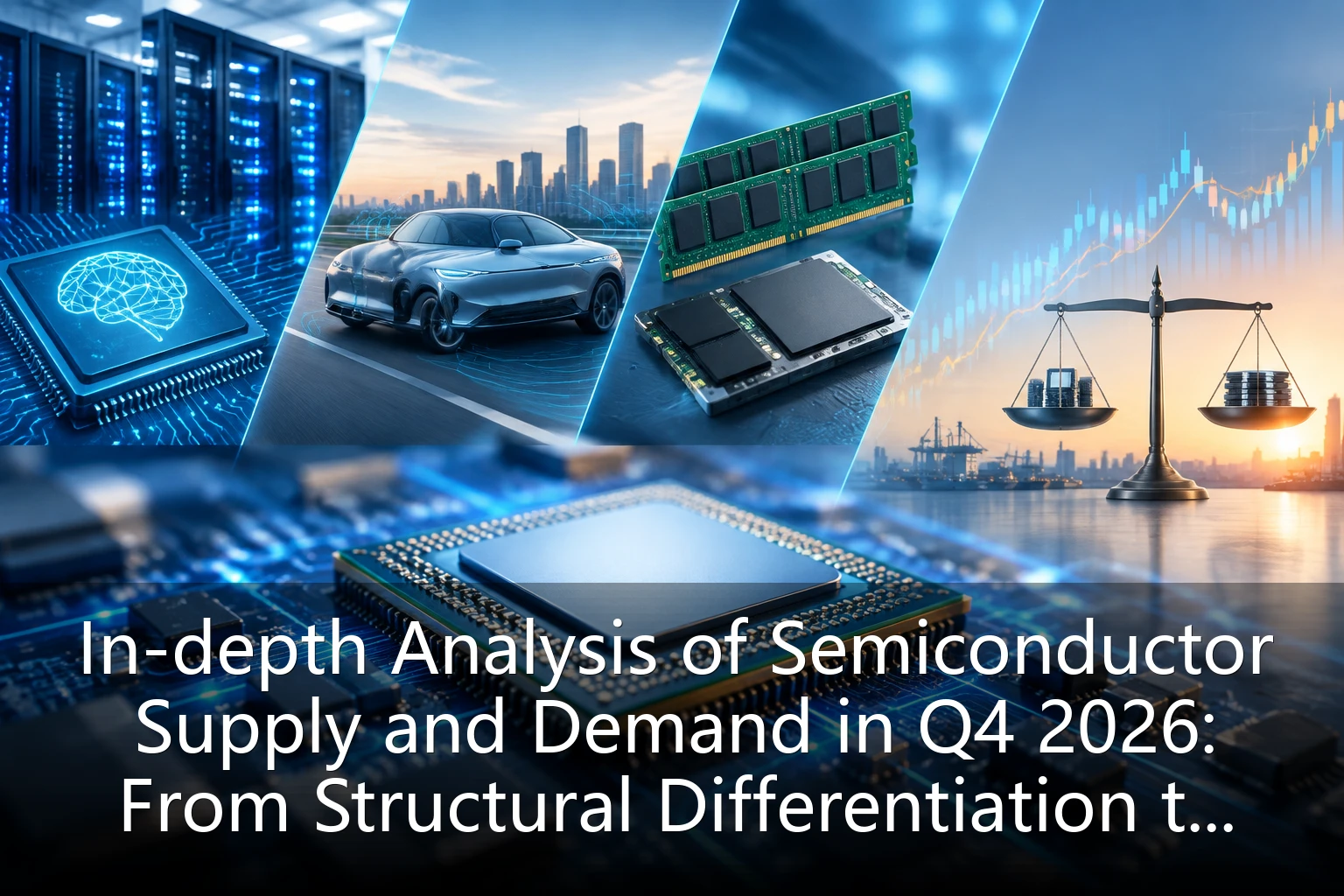
In-depth Analysis of Semiconductor Supply and Demand in Q4 2026: From Structural Differentiation to Market Rebalancing
\nIn 2026, the global semiconductor market entered a complex and critical turning point. With the explosive growth of artificial intelligence technology, increasing electrification of automobiles, and widespread deployment of IoT devices, the semiconductor industry is undergoing unprecedented structural changes. This report will deeply analyze the supply and demand landscape of the semiconductor market in Q4 2026, reveal the differentiation trends in various sub-sectors, and look forward to future market development trends and investment opportunities.
\n\nOverall Semiconductor Market Supply and Demand: From Shortage to Rebalancing
\nIn Q4 2026, the global semiconductor market showed obvious structural differentiation characteristics. On one hand, high-end products represented by AI computing chips continued to be in short supply with firm prices; on the other hand, the traditional consumer electronics chip market gradually moved toward supply-demand balance, with some products even showing temporary oversupply. This differentiation reflects that the semiconductor industry is undergoing profound technological and market changes.
\n\nAccording to industry data, global semiconductor sales in Q3 2026 increased by 18% year-on-year, but the growth rate slowed compared to previous quarters. This trend indicates that after several years of rapid growth, the semiconductor market is gradually returning to rationality, and the supply-demand relationship is starting to move toward rebalancing. It is worth noting that this rebalancing is not simply a case of "supply exceeding demand," but a structural adjustment between different technology nodes and application fields.
\n\nAI Chips: Polarized Supply and Demand, High-end Products Continue to be in Short Supply
\nThe vigorous development of the artificial intelligence field is reshaping the supply and demand pattern of the semiconductor market. In Q4 2026, the AI computing chip market showed a typical "pyramid" structure: high-end training chips were in short supply, mid-end inference chips basically balanced supply and demand, while low-end AI accelerators faced certain supply pressure.
\n\nIn the high-end AI chip market, products from leading manufacturers such as NVIDIA and AMD were still in short supply, with delivery cycles generally ranging from 6-9 months. This tight situation mainly stems from the continuous demand for AI computing power from large technology companies and the explosive growth of generative AI applications. Especially in the data center field, the demand for high-end GPUs far exceeded supply capacity, leading to continuous price increases.
\n\nMeanwhile, manufacturers in regions such as China and South Korea are accelerating their layout in the AI chip market, trying to fill the supply gap for high-end products. However, due to technical barriers and ecosystem limitations, it is difficult to fully meet market demand in the short term. This supply-demand imbalance is expected to continue until 2027, bringing investment opportunities to the related industrial chain.
\n\nAutomotive Electronics: Chip Demand Continues to Grow, Supply Chain Restructuring Accelerates
\nThe increasing electrification of automobiles is one of the key factors driving semiconductor demand growth. In Q4 2026, the automotive chip market showed a trend of "both quantity and price rising." With the popularization of smart driving and vehicle networking technology, the semiconductor content in a high-end car has exceeded $1,000, an increase of nearly 40% compared to five years ago.
\n\nIn the automotive chip field, the demand for power semiconductors, MCUs, sensors, and image processing chips is particularly strong. Especially the application of wide bandgap semiconductor materials such as silicon carbide (SiC) and gallium nitride (GaN) in automotive power electronics is reshaping the entire supply chain landscape. Traditional automotive chip suppliers such as Infineon and STMicroelectronics are facing fierce competition from emerging manufacturers, and the market structure is accelerating its restructuring.
\n\nIt is worth noting that the automotive chip supply chain is shifting from "globalization" to "regionalization." To reduce geopolitical risks, automobile manufacturers are actively promoting supply chain diversification and increasing the proportion of local procurement. This trend brings new development opportunities for regional semiconductor suppliers while also presenting new challenges for global supply chain management.
\n\nMemory Chips: Cyclical Fluctuations Coexist with Structural Changes
\nThe memory chip market has always had strong cyclical characteristics. In Q4 2026, DRAM and NAND flash markets showed different trends: the DRAM market supply and demand tended to balance with relatively stable prices; while the NAND flash market, due to capacity expansion and weaker-than-expected demand, showed temporary oversupply, with prices declining.
\n\nAt the technical level, memory chips are undergoing a transition from traditional planar structures to 3D stacking structures. Especially in the NAND flash field, the number of 3D stacking layers is continuously increasing, from 200 layers in 2025 to more than 230 layers in 2026. Although this technological progress has increased storage density, it has also brought challenges in yield control and cost management.
\n\nIt is worth noting that the application scenarios of memory chips are undergoing structural changes. The demand for high-performance, low-latency storage from data centers and AI computing continues to grow, driving the market share increase of high-end memory chips. Meanwhile, the demand growth for memory chips in the consumer electronics market is slowing, prompting manufacturers to accelerate their transformation toward enterprise and industrial markets.
\n\nFoundry: Widening Gap Between Advanced and Mature Processes
\nThe foundry market is a core link in the semiconductor supply chain. In Q4 2026, the advanced and mature process markets showed completely different development trends: advanced process capacity continued to be tight with firm prices; while mature processes faced relatively excess capacity and increased competition.
\n\nIn the advanced process field, the 3nm and 5nm capacity of leading manufacturers such as TSMC and Samsung was still in short supply, with delivery cycles generally exceeding 6 months. This tight situation mainly stems from strong demand for high-end computing chips, smartphone SoCs and other products. Meanwhile, these manufacturers are accelerating their layout of processes below 2nm to maintain technological leadership advantages.
\n\nIn contrast, the mature process market (28nm and above) faces pressure of excess capacity. As the consumer electronics market growth slows, the capacity utilization rate of mature processes has decreased, and price competition has intensified. To cope with this challenge, foundries are actively expanding emerging application markets such as automotive, industrial control, and IoT, and optimizing product portfolios to improve profit margins.
\n\nSupply Chain Restructuring: From Globalization to Diversification
\nGeopolitical factors and pandemic experience have prompted the acceleration of semiconductor supply chain restructuring. In Q4 2026, "supply chain diversification" has become industry consensus, with major manufacturers actively adjusting their global layout to reduce dependence on single regions or suppliers.
\n\nIn terms of regional layout, the United States encourages domestic semiconductor manufacturing through the "Chip and Science Act," the EU has launched the "European Chips Act" to strengthen industrial chain resilience, and Japan and South Korea have also increased their investment. This regional trend is reshaping the global semiconductor industry landscape, bringing new development opportunities to various regions.
\n\nIn terms of supply chain management, "nearshoring" and "friendshoring" have become new trends. To shorten supply chain distance and improve response speed, electronics manufacturers are transferring some capacity to regions closer to end markets. This change puts new requirements on semiconductor suppliers, prompting them to reassess their global layout strategies.
\n\nInventory Changes: From "Destocking" to "Strategic Stockpiling"
\nIn Q4 2026, semiconductor inventory management strategies are undergoing significant changes. After the "destocking" phase of the past two years, the overall industry inventory level has returned to a healthy range. However, with increasing supply chain risks, leading manufacturers are shifting to a "strategic stockpiling" model, with inventory levels of key products higher than before the pandemic.
\n\nIn terms of inventory structure, different sub-sectors show obvious differences: high-growth areas such as AI chips and automotive chips have lower inventory levels and longer delivery cycles; while consumer electronics chip inventory levels are relatively high, with some products even showing temporary oversupply. This differentiation reflects different industry expectations for market prospects.
\n\nIt is worth noting that inventory turnover rate is becoming an important indicator to measure the operational efficiency of semiconductor enterprises. Against the background of increasing demand fluctuations, companies that can quickly adjust inventory levels and improve turnover efficiency will gain stronger market competitiveness. This prompts manufacturers to strengthen digital transformation of the supply chain, using AI and big data technologies to optimize inventory management.
\n\nInvestment Outlook: Structural Opportunities and Long-term Value
\nLooking ahead, the semiconductor industry will usher in more structural investment opportunities. Based on the supply-demand analysis of Q4 2026, we believe the following areas deserve attention: AI computing chips, automotive electronics, third-generation semiconductors, advanced packaging technologies, and semiconductor equipment materials.
\n\nIn terms of investment strategy, it is recommended to focus on enterprises with core technical advantages that can grasp structural changes. Especially in high-growth areas such as AI chips and automotive electronics, companies with differentiated products and technical barriers are expected to achieve excess returns. Meanwhile, with the acceleration of supply chain restructuring, regional semiconductor suppliers will also face development opportunities.
\n\nIn the long term, the semiconductor industry will maintain its growth momentum. Although it may face cyclical fluctuations in the short term, the general trend of digital transformation and intelligent upgrading will not change. Investors should focus on long-term value, paying attention to enterprises' technological innovation capabilities and sustainable development potential, rather than short-term market fluctuations.
\n\nConclusion: The Path to Rebalancing Under Structural Differentiation
\nIn Q4 2026, the semiconductor market is in a critical period of transitioning from structural differentiation to rebalancing. The strong growth in emerging fields such as AI chips and automotive electronics forms a sharp contrast with the relative weakness in the consumer electronics market, reflecting that the industry is undergoing profound technological and market changes.
\n\nFacing the complex and changing market environment, semiconductor enterprises need to flexibly adjust their strategies and grasp structural opportunities. On one hand, it is necessary to increase R&D investment to maintain leading advantages in key technology fields; on the other hand, it is necessary to optimize supply chain layout and improve risk resistance capabilities. Meanwhile, investors should also take a long-term perspective, focusing on enterprises with core technical advantages and sustainable development potential.
\n\nWith the continuous advancement of semiconductor technology and the expansion of application scenarios, the industry will usher in broader development space. Although it may face cyclical fluctuations and structural adjustments in the short term, in the long run, semiconductors, as the cornerstone of the digital economy, will continue to maintain growth momentum, providing strong support for the global economic transformation and upgrading.