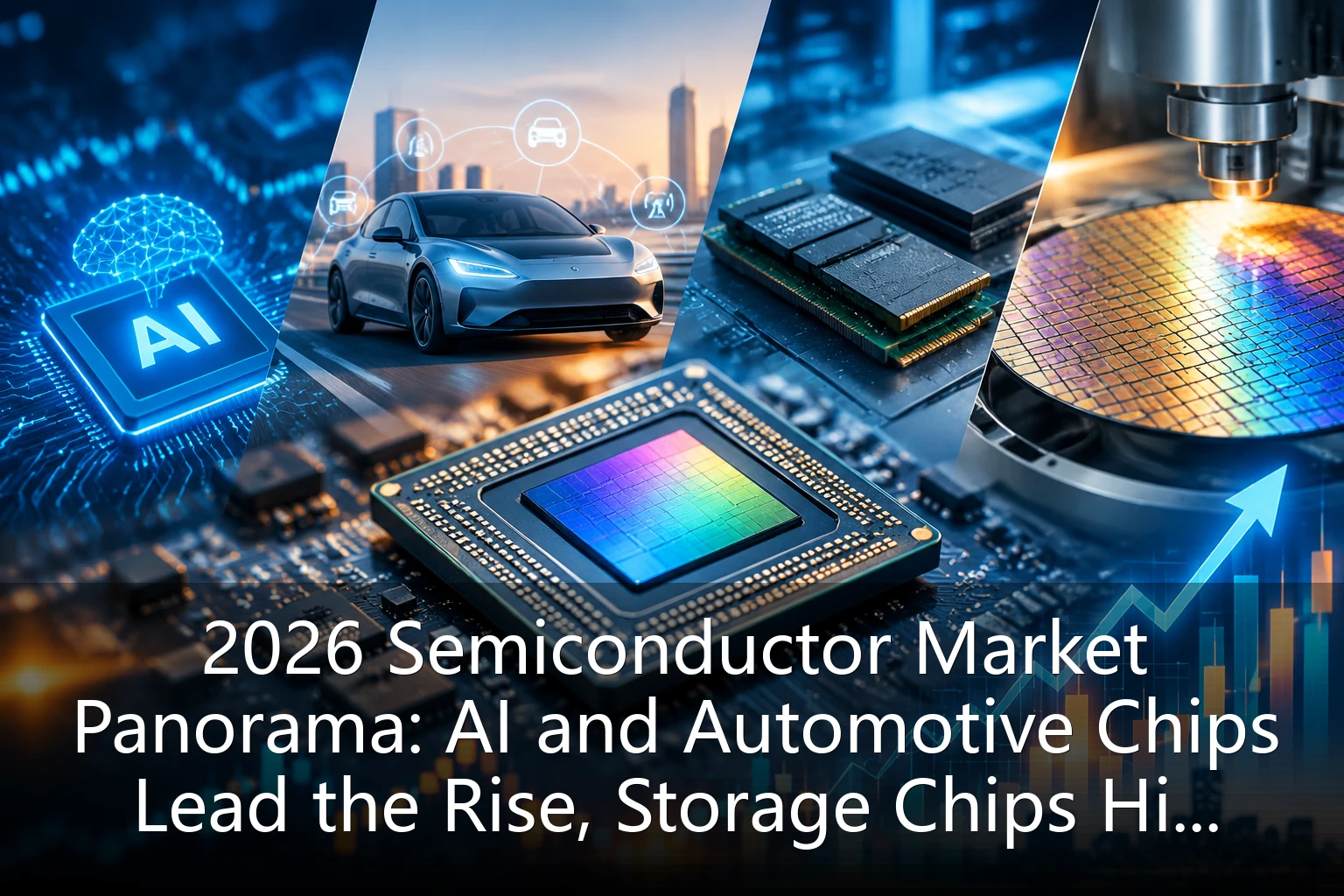
2026 Semiconductor Market Panorama: AI and Automotive Chips Lead the Rise, Storage Chips Hit Recovery Turning Point
\n\nIn September 2026, the global semiconductor market shows clear structural differentiation. With explosive growth in AI applications and deepening advancement in automotive electrification and intelligence, AI chips and automotive chips continue to lead the market with rising prices. Meanwhile, after two years of adjustment, the storage chip market has finally reached a recovery turning point with gradually improving supply-demand dynamics. This article comprehensively analyzes the latest trends in the current semiconductor market, interprets performance across various segments, and looks ahead to future development trends.
\n\nAI Chip Market: Computing Demand Continues to Surge, Prices Steady with Increases
\n\nIn September 2026, the AI chip market maintained strong growth momentum. According to the latest market data, the global AI chip market size grew by over 35% year-on-year, with data center AI chip shipments increasing by 42% and edge computing AI chips growing by 28%. This growth is mainly driven by the continuous expansion of large language models, computer vision, and generative AI applications.
\n\nLooking at price trends, AI chips continued their upward trajectory in Q3 2026. High-end training chip prices rose by 15% compared to the beginning of the year, while inference chip prices increased by approximately 8%. Industry analysts note that this round of price increases is not a short-term phenomenon but reflects structural growth in AI computing demand. As model parameter scales continue to expand and training complexity increases, demand for high-performance AI chips will remain strong.
\n\nIn terms of supply, leading chip manufacturers are actively expanding advanced process capacity. TSMC's CoWoS packaging capacity utilization remains above 95%, with 3nm process capacity continuing to be tight. Major AI chip vendors such as NVIDIA, AMD, and Intel have announced expansion plans, with more capacity expected to be released from the second half of 2026 to 2027.
\n\nAutomotive Chips: Dual Drivers of Electrification and Intelligence, Sustained Demand Growth
\n\nThe automotive chip market maintained strong growth in September 2026. As the global EV penetration rate exceeds 35% and automotive intelligence levels continue to rise, the chip value per vehicle steadily increases. Data shows that automotive chip sales in Q3 2026 grew by 22% year-on-year, with EV chips increasing by 28% and traditional fuel vehicle chips growing by 8%.
\n\nLooking at sub-sectors, autonomous driving chips, automotive-grade MCUs, and power semiconductors are the three fastest-growing categories. Demand for L3 and above autonomous driving chips has surged, with related vendor orders already extending into 2027. Automotive-grade MCUs benefit from upgrades in automotive electrical and electronic architectures, maintaining strong demand. Power semiconductors benefit from the pursuit of higher efficiency and power density in EV control systems.
\n\nIn terms of pricing, automotive chips overall increased by 5-10% in Q3 2026. Particularly automotive-grade MCUs and power semiconductors continue to face supply-demand tightness due to relatively slow capacity expansion. Industry experts expect that as new capacities from major chip vendors gradually come online, automotive chip prices will stabilize in 2027.
\n\nStorage Chips: Improved Supply-Demand Dynamics, Prices Bottom Out and Rebound
\n\nAfter two years of adjustment, the storage chip market finally reached a recovery turning point in September 2026. Both DRAM and NAND Flash prices have bottomed out and rebounded, with market supply-demand relations gradually improving. Data shows that DRAM contract prices rose by 8% quarter-on-quarter in Q3 2026, while NAND Flash contract prices increased by 5%, marking the first time since 2024 that both have seen increases for two consecutive quarters.
\n\nThis recovery is mainly driven by the following factors: first, the global PC and smartphone markets have gradually recovered after adjustment, boosting consumer storage demand; second, AI servers' demand for high-performance storage continues to grow, maintaining stability in the data center storage market; finally, after prolonged capacity adjustments, storage vendors have significantly reduced supply, with inventory levels reaching historical lows.
\n\nLooking at sub-markets, HBM (High Bandwidth Memory) has shown particularly outstanding performance benefiting from AI computing demand. The HBM4 standard has been formally established, with Samsung, SK Hynix, and Micron announcing mass production plans. Industry analysts expect the HBM market to maintain growth of over 30% in the second half of 2026, becoming the largest growth area in the storage chip sector.
\n\nWidening Gap Between Mature and Advanced Processes, Industrial Restructuring
\n\nIn September 2026, the divergence between mature and advanced semiconductor manufacturing processes has further intensified. Advanced processes (7nm and below) continue to be in short supply, while mature processes (28nm and above) face structural adjustments. Data shows that advanced process foundry prices have risen by 10% since the beginning of the year, while mature process prices have remained basically flat, with some nodes even seeing slight declines.
\n\nThis divergence reflects different application demands for process nodes. AI chips, high-end smartphones, and HPC (High Performance Computing) have strong demand for advanced processes, driving sustained tightness in 7nm, 5nm, and 3nm capacity. Meanwhile, consumer electronics, automotive electronics, and IoT focus more on cost-effectiveness, extensively using mature processes.
\n\nIn the mature process sector, the industry is undergoing structural adjustment. On one hand, excess traditional logic process capacity has led to intense price competition; on the other hand, demand for specialized processes like power semiconductors, image sensors, and CIS (Complementary Metal-Oxide-Semiconductor) has increased, boosting capacity utilization for related processes. Industry experts predict that mature processes will show a "structural differentiation" pattern in the coming years, with some nodes facing excess capacity while specialized processes remain in short supply.
\n\nFoundry Market: Optimized Capacity Allocation, Adjusted Pricing Strategies
\n\nIn Q3 2026, the global foundry market exhibits clear "dual-track" characteristics. Advanced process capacity remains tight, with foundries raising prices; mature processes have relatively loose capacity, with foundries adopting differentiated pricing strategies to compete for market share.
\n\nTSMC continues to lead the global foundry market, with 3nm process capacity utilization approaching 100% and 5nm process utilization exceeding 95%. Samsung and GlobalFoundries are increasing investment in advanced processes, gradually releasing 7nm and 5nm capacity. Mainland Chinese foundries like SMIC and Huahong Semiconductor continue to focus on mature processes and mid-end technologies, showing clear advantages in specialized processes.
\n\nRegarding pricing strategies, advanced process foundries generally adopt "step-wise" pricing, offering different discounts based on customer order volume and degree of long-term cooperation. Mature process foundries are more flexible, developing differentiated price strategies for different customers and application scenarios. Industry analysts note that these pricing strategies reflect structural changes in the foundry market, with the "premium" for advanced processes continuing to exist while the "price war" in mature processes will moderate.
\n\nSemiconductor Supply Chain: From Inventory Reduction to Strategic Stockpiling, New Paradigm Emerges
\n\nIn September 2026, the global semiconductor supply chain is transitioning from "inventory reduction" to "strategic stockpiling." After two years of inventory adjustment, semiconductor industry inventory levels have returned to healthy ranges. Data shows that global semiconductor inventory turnover days fell to 65 days in Q3 2026, approaching historical normal levels.
\n\nMeanwhile, geopolitical factors and supply chain security considerations are prompting companies to adopt "strategic stockpiling" strategies. Major end-users and first-tier suppliers are increasing safety stock of critical chips to potential supply disruption risks. This "strategic stockpiling" differs from traditional "hoarding" and is based on risk assessment, expected to become the new industry norm.
\n\nIn terms of supply chain layout, "regionalization" and "diversification" trends are increasingly evident. Major semiconductor vendors are accelerating regional capacity deployment to shorten supply chain distances and improve response speed. At the same time, supply chain diversification has become an important strategy, with companies no longer relying on single suppliers or regions but building multi-layered supply networks.
\n\nInvestment Strategy and Future Outlook
\n\nBased on the latest trends in the September 2026 semiconductor market, investors can adopt the following strategies: first, focus on leading companies in AI and automotive chips, which will continue to maintain high growth; second, seize investment opportunities brought by storage chip recovery, especially in the HBM-related industry chain; finally, pay attention to structural opportunities in specialized processes and mature nodes, such as power semiconductors and CIS.
\n\nLooking ahead, the semiconductor market will show the following development trends: first, AI computing demand will continue to drive high-end chip development, maintaining investment enthusiasm in advanced processes; second, automotive electrification and intelligence will drive long-term growth in automotive chips; third, the storage chip market will enter a new upward cycle, with HBM becoming an important growth point; fourth, semiconductor supply chain will continue to restructure, with regionalization and diversification becoming mainstream.
\n\nOverall, the September 2026 semiconductor market shows characteristics of both structural differentiation and structural recovery. AI and automotive chips lead the rise, storage chips hit a turning point, and the gap between mature and advanced processes widens. This differentiated landscape reflects profound changes in the semiconductor industry, also providing rich investment opportunities for investors. While grasping market trends, investors also need to pay attention to long-term factors such as geopolitics, technological changes, and supply chain restructuring to make rational decisions.